


Functional Rehabilitation of the Near Vision System in Presbyopia
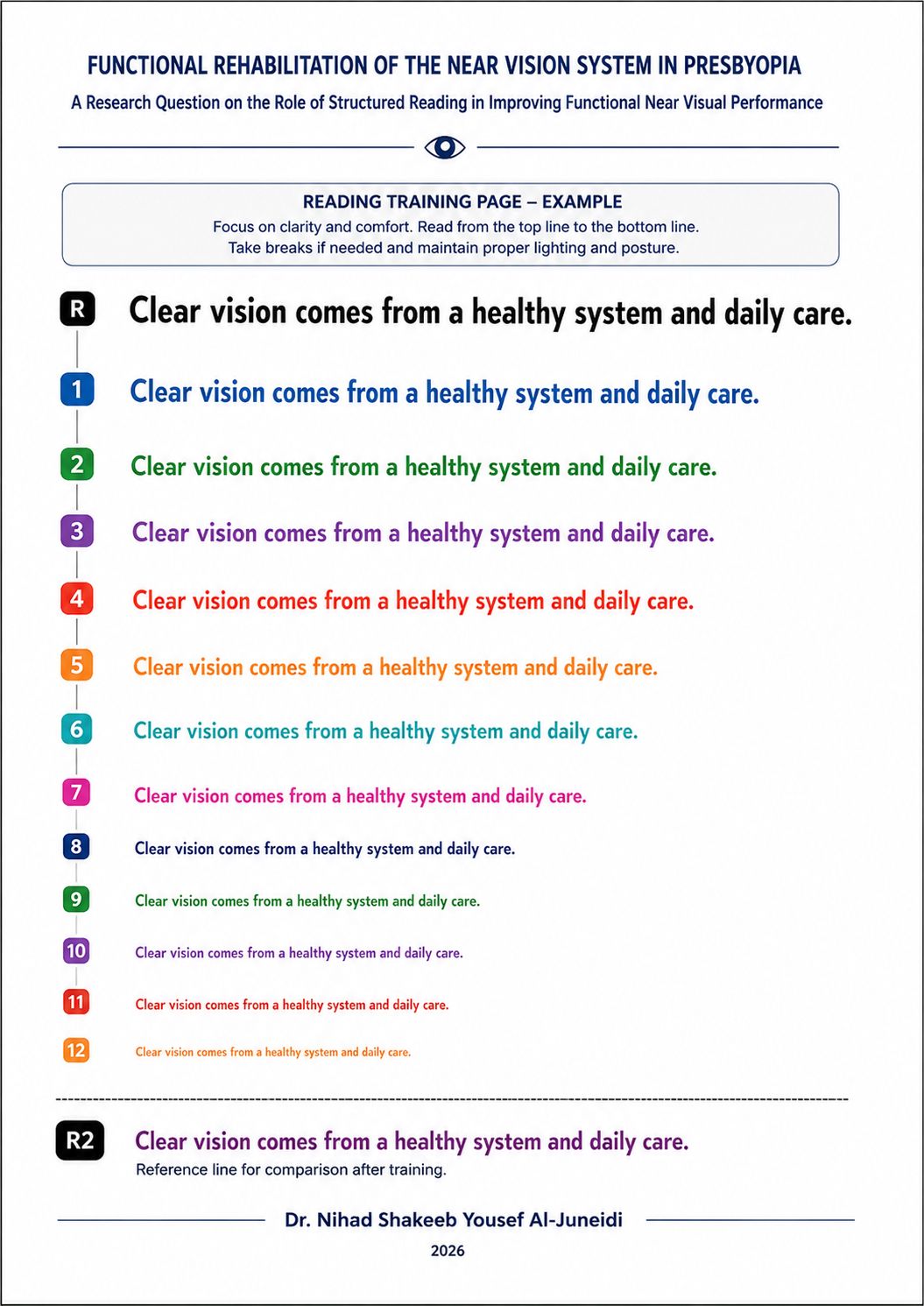
Functional Rehabilitation of the Near Vision System in Presbyopia:
A Research Perspective on Structured Reading as a Functional Visual Training Paradigm
Dr. Nihad Shakeeb Yousef Al-Juneidi
Introduction
Presbyopia remains one of the most prevalent age-related visual conditions worldwide, affecting a growing number of individuals as life expectancy continues to increase.
The condition is generally associated with age-related changes in the accommodative apparatus, including progressive alterations of the crystalline lens and a decline in accommodative function, resulting in increasing difficulty with near visual tasks such as reading, digital device use, and other activities requiring sustained near vision.
For decades, scientific understanding of presbyopia has focused primarily on age-related alterations within the accommodative apparatus, particularly changes involving the crystalline lens and associated ocular structures. Consequently, current management strategies have largely centered on optical correction, pharmacological interventions, and surgical procedures.
Despite significant advances in these approaches, near vision itself represents a complex functional process that extends beyond any single anatomical structure.
Reading, for example, is not merely a passive optical event. It requires the coordinated interaction of multiple physiological systems, including accommodation, pupillary dynamics, vergence mechanisms, ocular motility, visual attention, and higher neural processing pathways. Together, these components form an integrated functional network responsible for sustained near visual performance.
⸻
A Research Question
This observation raises an important scientific question:
If near visual performance depends upon the coordinated interaction of multiple functional systems, could structured visual activities contribute to measurable changes in functional near visual performance in selected individuals?
This question does not challenge established physiological concepts of presbyopia. Rather, it seeks to explore whether additional functional dimensions of near vision may warrant further scientific investigation.
⸻
Structured Reading as a Research Framework
One potential approach to investigating this question involves the use of structured reading activities performed under controlled and measurable conditions.
The proposed framework incorporates specially designed reading materials consisting of text presented through progressively changing font sizes and controlled color variations arranged according to a predefined sequence. The reading materials further include reference comparison lines and standardized reading conditions intended to generate graduated visual demands during near-vision tasks.
These elements constitute the core components of the proposed research framework and are designed to facilitate the investigation of functional aspects of near visual performance under structured reading conditions.
At present, these variables should be regarded solely as investigational components within a research model. They are not presented as established therapeutic interventions and are not intended to replace accepted clinical management strategies for presbyopia.
Rather, they are proposed as research tools intended to explore potential relationships between structured reading activities, visual adaptation, and functional aspects of near visual performance.
⸻
Proposed Reading Framework Components
The proposed framework is based on the use of structured reading materials specifically designed for the investigation of functional aspects of near visual performance.
These materials incorporate several standardized visual variables arranged according to a predefined sequence, including:
* Color-coded text.
* Progressively changing font sizes.
* Systematic progression from larger text elements toward smaller text elements.
* Reference comparison lines positioned before and after reading sessions.
* Standardized reading distances.
* Graduated visual task demands.
* Functional monitoring of near visual performance.
Unlike conventional reading materials, the proposed framework utilizes an organized progression of visual parameters rather than random presentation. This structured arrangement is intended to facilitate the observation and evaluation of functional responses during near-vision activities under standardized conditions.
Future investigations may incorporate quantitative outcome measures including reading distance, reading comfort, reading endurance, task performance, subjective visual function, and other indicators relevant to near visual activity.
⸻
Functional Vision and Neurovisual Adaptation
Functional systems throughout the human body demonstrate varying degrees of adaptation in response to repeated task-specific activity.
Whether similar principles may contribute to aspects of near visual performance remains an open scientific question deserving systematic investigation.
The possibility that structured visual activities could influence reading performance, visual comfort, subjective visual function, or other functional parameters warrants objective evaluation through carefully designed clinical studies.
⸻
Future Directions
The purpose of this perspective is not to propose conclusions, but to encourage inquiry.
Scientific progress frequently begins with a question that challenges researchers to examine familiar problems from new angles.
Future clinical trials, independent replication studies, and rigorous scientific evaluation will ultimately determine whether structured reading paradigms hold any meaningful role in the investigation of functional near visual performance in presbyopia.
Conclusion
Presbyopia continues to represent a major global visual challenge.
While contemporary management approaches provide valuable solutions for millions of individuals, opportunities remain to explore the broader functional characteristics of the near vision system.
Whether structured reading can contribute to our understanding of functional visual performance remains uncertain. Nevertheless, the question itself may deserve scientific attention.
⸻
Dr. Nihad Shakeeb Yousef Al-Juneidi
First Published Online: June 2026